
Live entertainment has moved beyond static backdrops and fixed visual layouts. Concerts, festivals, theatrical productions, and outdoor events increasingly use dynamic imagery to shape atmosphere, guide attention, and extend the visual identity of a performance. An LED screen for stage can function as a backdrop, architectural element, information surface, or interactive visual layer, depending on how it is integrated into the production. At Coblinks, we view this technology as part of the creative environment, where display characteristics and stage design work together rather than existing as separate elements.
Expanding the Visual Language of Live Performances
Traditional stage scenery occupies a defined physical space, while an LED screen for stage can change its appearance from one moment to the next. A scene can shift from abstract patterns to live camera footage without rebuilding the physical environment. This flexibility gives creative teams more control over pacing, transitions, and visual storytelling throughout a performance.
Screen placement also influences how audiences experience a venue. A large rear display can establish the visual foundation of a concert, while narrower surfaces around performers can add depth and movement. Side screens may carry supporting information without competing with the central performance area.
Content resolution needs to correspond with the physical scale of the display. Fine details that appear impressive on a production monitor may become difficult to interpret after being enlarged across a large stage. Designers should consider viewing distance, aspect ratio, camera framing, and the intended role of each display before producing final media.
Creating More Flexible Stage Configurations
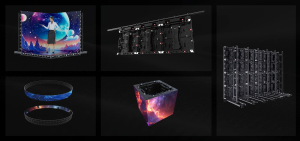
Stage design is no longer restricted to rectangular backdrops. With an LED screen for stage, curved surfaces, freestanding structures, suspended elements, and irregular arrangements can create a stronger connection between digital content and physical architecture. Such configurations are particularly useful when the display itself is intended to become part of the scenery.
Our Coblinks MB-H Series demonstrates this design direction through lightweight yet rugged modules that can support curved, freestanding, and architectural configurations. Its wide viewing angle and color consistency are suited to outdoor environments where audiences may watch from substantially different positions. The combination of physical flexibility and visual uniformity gives production teams more possibilities when developing unconventional screen layouts.
A Stage LED Screen can also influence how performers interact with the stage. Visual content positioned around or behind an artist can establish depth, while carefully timed graphics can reinforce choreography, music changes, or narrative sequences. The screen becomes a spatial component rather than simply a surface displaying video.
Adapting Visual Performance to Different Venues
Every live venue presents its own lighting conditions. Indoor theaters may have controlled illumination, whereas outdoor concerts can involve direct sunlight, changing weather, and large differences between daytime and nighttime viewing. Display brightness should be considered alongside contrast and ambient light instead of being treated as an isolated specification.
Viewing angle becomes especially important in large venues. Not every audience member stands directly in front of the display, and side positions can change perceived color and image consistency. A wide viewing angle can help maintain a more coherent visual experience across different sections of the audience.
Outdoor productions also demand attention to environmental exposure. Rain, dust, temperature changes, and physical handling can influence the practical operation of temporary display systems. The appropriate protection level depends on the venue, installation duration, storage conditions, and whether the equipment will move repeatedly between locations.
Connecting Screens with Live Production Workflows
Visual technology becomes more effective when it integrates naturally with the rest of the production system. Media servers, processors, cameras, lighting consoles, and control equipment may all contribute to what appears on the display. Signal formats and processing capabilities should be reviewed early so that creative plans remain compatible with the technical infrastructure.
Camera-based events require particular attention to refresh behavior and image processing. A display that looks smooth to spectators can still produce undesirable artifacts through a broadcast camera if its operating parameters do not align with the camera setup. Testing should use the actual content and camera equipment whenever the screen forms part of a filmed or streamed production.
Content operators working with a Stage LED Screen also benefit from clear screen mapping. Large or irregular configurations can involve multiple cabinets and processing zones, so accurate mapping helps graphics appear in the intended positions. A well-organized control workflow allows visual teams to make changes during rehearsals without introducing unnecessary disruption to the rest of the show.
Conclusion
Digital stage technology has changed the relationship between performance, architecture, and visual storytelling. Rather than functioning only as a large video backdrop, a display can shape spatial perception, respond to live content, and adapt its appearance throughout an event. The strongest results come from treating screen design, content creation, venue conditions, and production control as connected decisions.
We at Coblinks see the Stage LED Screen as one component within that wider creative system. Its value depends not only on image quality but also on how naturally it fits the physical design and technical workflow of a production. As live entertainment continues to explore more immersive formats, flexible display technology gives creative teams additional ways to make the stage itself part of the story.