
Energy efficiency is becoming an increasingly important consideration when businesses invest in large-format digital displays. For outdoor advertising, sports venues, public spaces, and live events, an LED display may operate for many hours each day, making power consumption an important part of the total cost of ownership. At Coblinks, we believe an efficient display system should balance brightness, image quality, reliability, installation requirements, and long-term operating costs.
Why Energy Efficiency Matters for an Outdoor LED Screen
An outdoor LED screen must produce considerably higher brightness than an indoor display because it needs to remain visible under daylight and direct sunlight. However, higher brightness can also increase energy consumption if the display is operated continuously at maximum output.
For buyers, therefore, energy efficiency should not be considered separately from the actual application. A screen used for daytime advertising may require strong brightness during sunlight hours but substantially less output at night. Choosing the appropriate pixel pitch, brightness level, cabinet design, and control strategy can help balance visibility with electricity consumption.
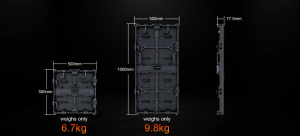
The physical design of the display also affects overall operational efficiency. A lightweight cabinet can simplify transportation and installation, while accessible maintenance can reduce labor requirements throughout the product lifecycle. These considerations are particularly relevant for professional buyers, integrators, and overseas rental companies purchasing LED panels for repeated deployment.
How Efficient Design Supports LED Screen for Advertising Outdoor Applications
For an LED screen for outdoor advertising, energy efficiency starts with selecting specifications that match the viewing environment. Excessive brightness is not necessarily beneficial if the display is installed where ambient light is lower. Conversely, insufficient brightness can reduce readability in direct sunlight and undermine the purpose of an advertising display.
Our MD Series provides outdoor pixel pitches of 2.9 mm, 3.91 mm, and 4.81 mm. The outdoor models have a rated brightness of 5000 cd/m², a refresh rate of at least 3840 Hz, a 140° horizontal and vertical viewing angle, and an IP65 protection rating. According to our product specifications, the three outdoor models have an average power consumption of 220 W/m² and a maximum power consumption of 664 W/m².
These figures provide buyers with a practical basis for estimating electrical requirements before selecting an outdoor LED screen. Actual energy use depends on content, brightness settings, operating hours, environmental conditions, and system configuration, so average and maximum consumption should both be considered during project planning.
Design Features That Can Improve Energy Efficiency
Energy consumption in an outdoor LED display is closely related to how the screen is configured and operated. Brightness is one of the main factors to consider. A display does not necessarily need to run at its maximum brightness throughout the day, so adjusting output according to daylight conditions can help avoid unnecessary power use while maintaining content visibility.
The MD Series is specified with a brightness of 5000 cd/m² and an average power consumption of 220 W/m², with maximum power consumption reaching 664 W/m². These figures give project planners a clearer reference when estimating electrical requirements. In actual operation, power demand can vary with brightness settings, displayed content, operating hours, and environmental conditions.
Screen size and operating schedules should also be considered together. A large display running continuously at high brightness will naturally require more energy than a smaller screen with controlled output and limited operating hours. For this reason, evaluating average consumption alongside expected usage patterns provides a more realistic basis for assessing the energy efficiency of an outdoor LED screen.
The goal is not simply to reduce power consumption, but to achieve the required outdoor visibility without using more energy than the application demands.
Choosing the Right Outdoor LED Screen for Long Term Use
When selecting an outdoor LED screen, professional buyers should consider several factors together. These include required brightness, pixel pitch, screen dimensions, operating schedule, local weather conditions, maintenance access, and expected service life.
For example, the MD outdoor series is specified for operating temperatures from -20°C to +50°C, working humidity from 10% to 90%, and a lifespan of at least 100,000 hours. Its IP65 rating is designed for outdoor environmental protection.
These specifications are important because an energy-efficient display that cannot reliably operate in its intended environment will not provide good long-term value. Efficient operation should always be combined with appropriate environmental protection and dependable maintenance.
At Coblinks, we develop and manufacture LED displays with a focus on technological development, customization, and practical project requirements. Our company was established in 2017 and operates a 5,000-square-meter manufacturing facility. We provide ODM services and customized LED display solutions for international customers, including clients in Europe, America, Japan, and Korea.
For customers seeking an LED screen for advertising outdoor, our approach is to match the display configuration with the application rather than applying one specification to every project. We can work with overseas partners and professional buyers to determine suitable panel configurations, installation requirements, and product specifications.
Building More Efficient Display Projects With Coblinks
An energy-efficient display project begins before installation. By evaluating brightness requirements, power consumption, operating hours, environmental conditions, maintenance access, and screen configuration together, buyers can make better-informed decisions about long-term operating costs.
LED display manufacturing, R&D, and customization form the foundation of Coblinks’ solutions for commercial and professional applications. Our MD Series demonstrates how lightweight construction, modular maintenance, outdoor protection, and clearly defined power specifications can work together in a professional display solution.
Energy consumption and overall system efficiency should be considered together when assessing the long-term value of an outdoor LED screen or an LED screen for advertising outdoor. With accurate specifications and application-focused engineering, we aim to help our customers build reliable LED display projects that deliver strong visual performance while supporting responsible long-term operation.