
Large-scale LED projects rarely follow a standard formula. A display may need a particular cabinet size, pixel pitch, mechanical structure, control configuration, or visual format to suit a specific venue and operating environment. For companies developing private-label products or customized display systems, the relationship with a China LED supplier can extend well beyond manufacturing.
At Coblinks, we work with project requirements at different stages, from product configuration and customization to production and technical support, so OEM and ODM programs can be developed around practical application needs.
Understanding the Difference Between OEM and ODM
OEM and ODM are often used interchangeably, although the two models involve different levels of product development. OEM generally refers to manufacturing a product according to specifications supplied by the customer, while ODM typically involves adapting an existing manufacturer’s design or developing a customized solution around the customer’s requirements.
The distinction matters because the amount of technical input can vary considerably. An OEM project may already have defined cabinet dimensions, LED components, electronics, mechanical structures, and branding requirements. An ODM program may instead begin with a functional objective, allowing the manufacturing partner to contribute to product architecture and engineering decisions.
Project complexity also depends on the intended market. A display intended for touring events may prioritize weight, assembly speed, and serviceability, whereas a fixed commercial installation could place greater emphasis on cabinet depth, thermal management, brightness, or installation structure. Defining these priorities early gives the manufacturing process a clearer technical direction.
Building a Practical Customization Process
Successful customization starts with specifications that can be translated into manufacturable components. Pixel pitch, cabinet dimensions, module configuration, brightness, refresh rate, viewing angle, power requirements, and maintenance access can all affect the final design. Small changes to one area may create consequences elsewhere, so technical discussions need to consider the display as a complete system.
A LED wall rental project illustrates why this flexibility can matter. Rental equipment may be assembled and dismantled repeatedly, making cabinet weight, mechanical connections, corner protection, and maintenance accessibility important considerations. A fixed-installation product intended for a permanent venue may require a substantially different construction approach.
Manufacturing capability is another part of the equation. A customized design still needs consistent assembly, component placement, testing, aging procedures, and quality control once it enters production. Without a stable manufacturing process behind the development work, an attractive prototype may be difficult to reproduce consistently at commercial volumes—a critical point for LED wall rental, where hardware must perform reliably across repeated transport and installation.
Using Product Platforms to Support Custom Projects
An established product platform simplifies customization because its core engineering is already tested. The manufacturer can then focus resources on adapting dimensions, configurations, mechanical details, or other project-specific requirements rather than developing every component from the ground up.
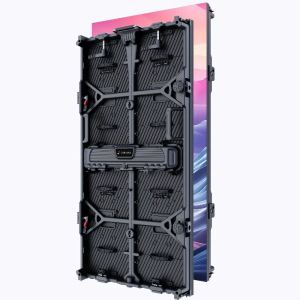
Our MD Series illustrates this platform-based approach. It supports indoor pixel pitches from 1.9 mm to 3.9 mm and outdoor options from 2.9 mm to 4.8 mm, with 500 × 500 mm and 500 × 1000 mm cabinet formats. The outdoor configurations use magnesium alloy, weigh 7 kg and 10.5 kg respectively depending on cabinet size, and provide 5,000 cd/m² brightness, ≥3,840 Hz refresh rate, IP65 protection, and front-and-rear maintenance. Curved configurations of 0°/±2.5°/±5° and irregular assembly are also supported.
Such a platform can reduce the number of fundamental design decisions required at the beginning of a project. The customization discussion can then focus on which established characteristics fit the application and which elements need modification. This approach can be particularly useful for distributors, integrators, or LED wall rental providers developing solutions for several market segments.
Why Technical Communication Matters in OEM and ODM
Specification accuracy becomes increasingly important as a project moves from concept to production. Terms such as brightness, refresh rate, pixel pitch, cabinet resolution, scanning mode, and power consumption should refer to defined technical parameters rather than broad marketing descriptions. Clear documentation helps different teams work from the same reference throughout development.
Communication between product teams and manufacturers also needs to cover practical installation conditions. Information about mounting, transportation, environmental exposure, service access, signal systems, and power infrastructure can reveal constraints that may not be obvious from a basic product specification.
As a China LED supplier, we support OEM and ODM projects through direct communication with our technical team and customized solutions. We provide technical consulting, specialized software, custom accessories, and project support, while our manufacturing operation includes SMT production lines and a 5,000-square-meter facility.
Conclusion
OEM and ODM display development is ultimately a coordination exercise between product requirements, engineering decisions, manufacturing processes, and real-world applications. A capable manufacturing partner should be able to understand the intended use, translate requirements into practical specifications, and maintain communication as the project moves toward production.
At Coblinks, we approach customized LED display projects through this combination of product platforms, technical development, manufacturing capability, and application knowledge. For companies seeking a China LED supplier, the value of the relationship is not limited to production capacity; it can also come from having a technical partner that understands how a display needs to function once it leaves the factory.