
Corporate events rarely follow a single visual format. A product launch may require bold stage imagery, a conference can depend on readable presentations, while an awards ceremony needs dynamic backgrounds that change throughout the program. An indoor rental LED display gives production teams a modular way to handle these different visual requirements without treating every event as a permanent installation.
At Coblinks, we approach this technology from the perspective of practical event production, where image quality, setup flexibility, viewing conditions, and operational reliability all need to work together.
Why Modular Displays Suit Event Environments
Temporary corporate events often take place in hotels, convention centers, ballrooms, exhibition halls, and other spaces with different structural conditions. An indoor rental LED display can be assembled in modular sections according to the available stage width and height, allowing the visual surface to adapt to the venue rather than forcing the venue to fit a fixed screen.
Physical transportation also becomes an important consideration. Event equipment may need to move through loading docks, elevators, backstage corridors, and storage areas before reaching the final position. Cabinet dimensions, weight, locking mechanisms, and maintenance access can influence how quickly crews move from delivery to installation.
Another practical advantage comes from configuration changes. A screen may be used as a wide backdrop during a keynote and then reorganized into a different layout for a networking session or evening program. Such adaptability makes an indoor LED display useful in production environments where the visual setup changes from event to event.
Image Quality and Audience Viewing
Corporate audiences do not always sit at the same distance from a stage. Front-row attendees may be close enough to notice pixel structure, while people toward the rear need sufficient brightness and contrast to distinguish presentation content. Pixel pitch should consequently be considered together with screen dimensions and the expected viewing distance.
Content resolution creates another layer of consideration. Fine text, presentation charts, corporate logos, product demonstrations, and video footage each place different demands on the display. A suitable configuration should reproduce small details without making ordinary content appear unnecessarily harsh or visually dense.
Lighting conditions can change dramatically during an event. A ballroom may begin with bright ambient lighting, transition into a darker presentation environment, and later use stage lighting with strong color effects. Display brightness, grayscale performance, contrast, and refresh rate all contribute to how consistently content appears across these transitions. For an indoor LED display, these factors matter because the same equipment may serve several production formats within a short period.
Technical Factors Behind Rental Production
Installation efficiency depends on more than cabinet assembly. Signal distribution, power planning, processor configuration, content resolution, and redundancy should be considered during technical preparation. A production team that maps these elements before installation can reduce unexpected adjustments once the audience enters the venue.
Cabinet design also affects the workflow backstage. Front and rear maintenance options can make troubleshooting more practical, while standardized dimensions simplify packing and arrangement. Weight matters as well, particularly when equipment must be lifted, moved between rooms, or installed on temporary structures.
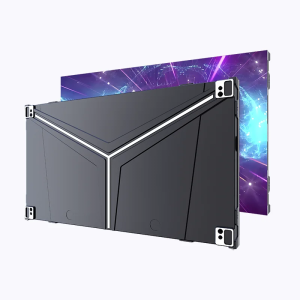
Our TC Series demonstrates another approach to visual performance. Its 0.9375mm pixel pitch uses common cathode flip-chip 4-in-1 LED technology, with a standard 16:9 format, reduced reflection, high contrast, and a uniform black surface. These characteristics are particularly relevant to corporate productions where detailed visual content and controlled presentation aesthetics are part of the viewing experience.
Planning a Reliable Event Workflow
Successful display deployment begins well before the equipment arrives at the venue. The production plan should define screen dimensions, audience layout, content sources, signal paths, power requirements, rigging conditions, and installation access. A technical drawing can reveal conflicts between the screen structure, lighting equipment, cameras, and stage elements before setup begins.
Content preparation deserves equal attention. Native resolution should correspond with the planned screen configuration, while aspect ratio should remain consistent across presentation slides, videos, and graphic materials. Testing playback devices and signal connections in advance can also reduce the chance of format-related problems during the live program.
Once the event begins, operators need clear procedures for content switching, monitoring, and fault handling. A visually impressive screen cannot compensate for poor coordination between the display operator, lighting crew, AV team, and event director. Good production practice treats the LED system as one component of a larger technical ecosystem rather than an isolated piece of equipment.
Conclusion
Corporate event production is built around change: different venues, different audiences, different stage designs, and different content can all appear within the same production schedule. Modular display technology fits this environment because it provides physical flexibility while allowing visual specifications to be matched with the demands of each event.
At Coblinks, we view the value of an indoor LED display through that wider production process. The right indoor rental LED display is not defined by pixel pitch alone; transportation, configuration, signal management, viewing distance, and content preparation all influence the final result. With those variables considered together, Coblinks can approach corporate display projects as integrated technical systems rather than simply screen installations.