
Retail environments compete for attention through more than merchandise alone. Store layout, lighting, digital content, and visual presentation all influence how shoppers perceive a space and interact with products. An LED display screen indoor can add moving imagery, promotional messages, brand storytelling, and product information without taking up the footprint of another physical fixture.
At Coblinks, we consider the value of display technology from this broader retail perspective, where visual communication needs to fit naturally into the architecture and the way customers move through a store.
Visual Communication Inside Modern Stores
Digital content gives retailers more flexibility than static printed graphics. Promotional campaigns can change throughout the day, seasonal messages can be updated remotely, and different sections of a store can communicate different themes without replacing physical signage. This flexibility makes indoor LED display technology useful for environments where content changes frequently.
Screen placement also affects how customers perceive information. A display positioned near an entrance can establish the visual identity of a store, while one placed beside a product category may provide demonstrations, styling ideas, or specifications. The most useful location is not always the largest available wall; sightlines, walking routes, ceiling height, and surrounding fixtures all influence whether content receives meaningful attention.
Retailers should also consider the distance between shoppers and the screen. Close-view installations can reveal pixel structure if the pitch is not suited to the environment, particularly around small text and detailed graphics. An LED display screen indoor solution should consequently be evaluated alongside viewing distance and content type rather than treated as an isolated hardware specification.
Pixel Density and Image Quality
Pixel pitch describes the distance between neighboring pixels, and smaller pitches provide greater pixel density within the same physical area. That additional density becomes valuable in premium retail environments where customers may stand close to the screen and notice fine details in fashion photography, product demonstrations, typography, or high-resolution video.
Image quality, however, involves more than pixel pitch. Refresh rate can influence the appearance of moving content and camera footage, while grayscale performance affects subtle transitions between darker and brighter shades. Viewing angle is another consideration because shoppers rarely remain directly in front of a screen throughout their visit.
Lighting conditions deserve equal attention. Retail spaces can contain spotlights, window illumination, decorative lighting, and reflective surfaces, creating a visually complex environment. Contrast and surface characteristics can influence how clearly digital content remains visible without competing unnecessarily with the products surrounding it. A carefully specified indoor LED display should complement the store’s lighting strategy rather than operate independently from it.
Slim Design and Installation Flexibility
Physical dimensions become especially important in retail because display equipment must coexist with shelves, signage, lighting, structural elements, and customer pathways. A slim cabinet can reduce the visual intrusion of a screen while making wall integration easier, particularly in boutiques and compact commercial interiors.
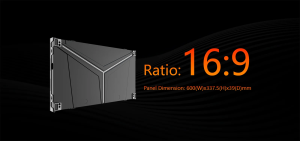
Our TC Series provides a specific example of this design approach. The panel uses advanced 4-in-1 flip-chip LED technology, has a profile of 39mm, and measures 600mm × 337.5mm with a standard 16:9 aspect ratio. Its high-precision mounting frame is designed around straightforward installation and seamless integration, while the 0.9375mm pixel pitch supports detailed close-range imagery. This combination is relevant to retail spaces where display proportions, surface depth, and visual refinement all matter.
Installation planning should extend beyond the panel itself. Electrical access, structural support, service clearance, cable routing, and content hardware need to be considered before the screen reaches the store. A visually attractive installation can still create operational difficulties if maintenance access or supporting infrastructure has been overlooked.
Content Strategy and Customer Experience
Digital signage becomes more effective when its content matches the customer’s position in the shopping journey. Entrance displays can focus on brand atmosphere or current campaigns, while screens deeper inside a store can explain product features, demonstrate usage, or present coordinated collections. The message should reflect what shoppers are likely to need at that particular point.
Content duration matters as well. A customer walking past a display has only a few seconds to absorb its message, whereas someone waiting near a fitting area may have considerably more viewing time. Typography, motion speed, image hierarchy, and information density should be adjusted accordingly instead of displaying the same material across every screen.
Retail teams can also use digital displays as part of broader campaign planning. New creative assets can be introduced alongside product launches, promotions can be synchronized with online activity, and visual themes can change according to store schedules. Such practices turn an LED display screen indoor from a decorative feature into a communication channel that can respond to changing commercial priorities.
Conclusion
Retail display technology works best when visual impact and physical practicality are considered together. Pixel density affects close-range detail, cabinet depth influences architectural integration, and content strategy determines whether shoppers can absorb information within the limited time they spend near a screen. None of these factors exists in isolation.
Our approach at Coblinks focuses on connecting those technical considerations with the realities of retail environments. An indoor LED display can support branding, product education, promotional communication, and atmosphere without relying on a single visual format. With the right combination of display characteristics and content planning, Coblinks can help retailers treat digital screens as part of the customer experience rather than simply another piece of store equipment.