
Outdoor advertising has entered a more adaptable phase. Instead of relying on one printed message for weeks or months, advertisers can now change visuals according to campaigns, schedules, locations, and audience patterns. Digital billboards make that shift possible by combining large-format visibility with programmable content, giving businesses more control over how their messages appear in public spaces. At Coblinks, we see this transition as a practical change in media planning: the display becomes a reusable communication platform rather than a surface tied to one campaign.
The Shift from Fixed Messages to Dynamic Content
Printed billboards have a straightforward advantage: once installed, the message remains visible without requiring a digital control system. Their limitation is equally clear, since changing the campaign normally requires new artwork, printing, transportation, and installation. Digital billboards avoid much of that cycle because content can be updated remotely, though they depend on power, connectivity, and control hardware.
Digital displays introduce a different workflow. Multiple advertisements can share one screen, and content can be scheduled around business hours, seasonal promotions, public events, or specific audience patterns. A campaign can also be updated without physically replacing the advertising surface.
That flexibility changes how media space can be planned. A retailer may promote one offer during the morning, another during the afternoon, and event-related content in the evening. The physical installation stays in place while the communication strategy evolves around it.
Making Better Use of One Display
A digital advertising asset becomes more valuable when it can serve different campaigns throughout its operating life. Instead of dedicating one physical surface to a single creative concept, advertisers can organize several content slots within the same display schedule.
Screen dimensions still influence the type of content that works well. Large outdoor surfaces are generally viewed from greater distances, so messages need strong visual hierarchy, recognizable imagery, and concise wording. Excessive text can reduce comprehension before passing viewers have enough time to read it.
Brightness should also be evaluated in relation to the environment. Direct sunlight, surrounding buildings, reflections, and viewing direction can all affect perceived visibility. A technically bright display may still produce an unsatisfactory advertising experience if contrast and content design are poorly matched to the location.
Understanding the Technology Behind Modern Billboards
Not every digital display has the same technical profile. Pixel pitch, refresh rate, grayscale processing, brightness, viewing angle, cabinet construction, and environmental protection can vary considerably between applications.
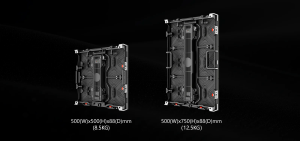
Our Coblinks MB Series illustrates a multi-purpose approach. Its pixel pitch options range from 1.25mm to 5.95mm, while the 500 × 500 × 88mm and 500 × 750 × 88mm cabinet formats can support rental, fixed-installation, and floor-tile applications. Such versatility can be useful for projects that require different deployment methods without maintaining entirely separate equipment systems.
For LED billboard advertising, however, specifications should always be assessed against the actual site. A roadside installation has different requirements from a shopping district display or an event-based advertising surface. Viewing distance, mounting height, traffic speed, operating hours, and weather exposure all influence the appropriate configuration.
Designing Content Around Human Attention
With LED billboard advertising, a larger screen does not automatically make a message easier to understand. Content has to account for how long viewers are likely to see it and whether they are pedestrians, passengers, or drivers.
Short exposure times favor simple visual structures. A strong headline, recognizable brand element, and one clear call to action can communicate more effectively than a crowded composition containing several competing messages. Typography should also remain legible from the expected viewing distance.
Motion adds another variable. Animated content can attract attention, but excessive transitions may make the message difficult to follow. Designers should establish a clear visual sequence so that the main information remains understandable even if someone sees only part of the advertisement.
Evaluating Long-Term Advertising Value
The financial case for digital outdoor media extends beyond the initial hardware purchase. Content production, electricity, maintenance, connectivity, structural support, installation conditions, and operating schedules all contribute to the total cost of ownership.
Operational flexibility can offset some of these expenses by allowing multiple campaigns to share the same physical asset. Businesses can also respond more quickly to changing promotions or market conditions without commissioning a new printed display each time.
Location quality remains fundamental. A highly capable screen positioned where few relevant viewers pass may produce less value than a simpler installation in a strategically useful location. Traffic volume, dwell time, audience characteristics, viewing angle, and nearby visual competition should all form part of the evaluation.
Conclusion
The move toward digital outdoor media is not simply a preference for brighter or larger screens. Businesses are adopting more adaptable communication systems that can accommodate multiple campaigns, changing schedules, and evolving creative requirements. Technology creates the flexibility, while location strategy and content discipline determine how effectively that flexibility is used.
We at Coblinks regard digital billboards as part of a wider advertising ecosystem rather than standalone hardware. Well-planned LED billboard advertising can make better use of valuable physical space by combining reusable infrastructure with changeable content. As businesses seek greater control over outdoor campaigns, that combination offers a practical alternative to advertising formats built around one fixed message.