
Electricity use can become a significant part of operating costs when a large digital display runs for many hours each day. An outdoor LED screen does not consume the same amount of power at every moment, since brightness, displayed content, operating schedules, and hardware configuration all influence demand. At Coblinks, we look at energy performance as part of the wider display system, where visual requirements and operating conditions need to work together rather than treating power consumption as a single isolated figure.
Understand What Drives LED Display Power Consumption
The brightness level has a direct relationship with power demand. A screen displaying a predominantly white image generally requires more energy than one showing darker content because more LEDs are driven at higher output. This difference becomes noticeable when large displays operate continuously across advertising campaigns, public events, or commercial installations.
Content design can consequently influence electricity use without changing the physical hardware. Darker backgrounds, moderate use of highly illuminated areas, and appropriately timed animations can reduce unnecessary full-screen brightness. Such adjustments are particularly useful when content remains visible for long periods but does not need maximum luminance throughout the entire operating cycle.
Screen size also matters. A larger display contains more LED modules, so its potential power requirement naturally increases with the illuminated area. Instead of focusing only on the nominal maximum consumption, project planning should consider average consumption, expected brightness, operating hours, and the percentage of the screen that typically displays bright content.
Manage Brightness According to Ambient Light
Daylight conditions change throughout the day, making a fixed brightness setting inefficient in many applications. A level suitable for strong afternoon sunlight may be excessive after sunset. Automatic or scheduled brightness management can adapt output to the environment while keeping the content visible.
The relationship between brightness and visibility deserves particular attention in open-air locations. Reducing output too aggressively can make important information difficult to read, which may encourage operators to compensate with larger text or repeated messages. A more balanced approach is to establish appropriate brightness levels for different periods and review them according to actual site conditions.
Ambient light sensors can support this process by providing information about surrounding illumination. Combined with control software, they can help displays move between brighter daytime settings and lower nighttime levels. The resulting energy savings depend on the operating environment and control strategy, but the principle is straightforward: there is little reason to run a display at its highest output when surrounding light no longer requires it.
Select Efficient Hardware and Plan Operation
Hardware selection affects the long-term energy profile of an installation. Outdoor LED screen panels with efficient components, suitable thermal management, and sensible power architecture can help control electricity demand while maintaining the required image quality. Cabinet design also influences maintenance and service efficiency, which can affect the broader operating cost of a display.
Operating schedules for outdoor LED screen panels provide another practical opportunity. A commercial display does not necessarily need to remain active at full output during periods of minimal audience traffic. Programming different brightness levels or switching the system into an appropriate standby state during low-demand periods can reduce unnecessary consumption.
Power distribution should also be planned according to the actual configuration. Large installations may contain multiple cabinets, control systems, processors, and auxiliary equipment, so evaluating only the LED modules gives an incomplete picture. Reviewing the entire electrical setup makes it easier to identify where operating practices can be improved.
A Lightweight MD Series Configuration
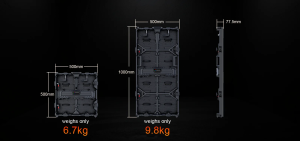
At Coblinks, our MD Series uses a magnesium-alloy frame designed to reduce cabinet weight while supporting practical installation and maintenance. Its 500 × 500 mm panel weighs 6.7 kg, while the 500 × 1000 mm panel weighs 9.8 kg. For outdoor configurations, the series offers 2.9 mm, 3.91 mm, and 4.81 mm pixel pitches, with an average power consumption of 220 W/m² and maximum power consumption of 664 W/m². The outdoor versions also provide 5,000 cd/m² brightness and IP65 protection.
Lower cabinet weight does not directly mean lower electrical consumption, so these two characteristics should not be confused. Weight primarily affects transportation, handling, installation, and structural requirements. Power efficiency, meanwhile, depends on LED components, brightness settings, content, control systems, and operating patterns.
The more useful approach is to consider energy together with the practical conditions of the installation. A display that can be transported and serviced efficiently may reduce costs in other areas even when its electrical specification remains unchanged. Likewise, selecting a pixel pitch based on actual viewing distance can prevent unnecessary investment in specifications that the audience cannot meaningfully perceive.
Conclusion
Energy management for an outdoor LED screen is not simply a matter of buying hardware with a lower power figure. Brightness control, content characteristics, operating schedules, screen dimensions, component efficiency, and maintenance practices all contribute to the final electricity profile. The most practical strategy is to match each factor with the actual environment instead of applying one setting across every situation.
At Coblinks, we consider these operating realities when developing display solutions, while recognizing that energy use ultimately depends on how a system is configured and operated. Thoughtful planning can make outdoor LED screen panels more economical to run without sacrificing the visibility that makes digital outdoor communication useful.