
A strong visual presence can shape how people remember a brand long after an event has ended. An outdoor LED screen can display motion graphics, product imagery, announcements, and campaign messages at a scale that traditional printed signage cannot easily match. Visibility, however, is not determined by screen size alone.
Content contrast, viewing distance, location, ambient light, message timing, and audience movement all influence whether a display attracts attention and communicates clearly. At Coblinks, we approach these factors as connected parts of an effective visual communication strategy.
Visibility Begins with the Right Viewing Environment
Outdoor audiences rarely experience advertising under controlled lighting. Bright daylight, changing weather, shadows from surrounding structures, and nighttime illumination can all alter how content appears. A display intended for an open plaza may require different visual considerations from one positioned beside a stadium entrance, even if both are showing the same campaign.
Brightness is particularly relevant during daylight hours. If the output is too low, important details may become difficult to distinguish against sunlight. Excessive brightness, on the other hand, can make nighttime content uncomfortable to view and may affect the visual balance of the surrounding environment. Content teams should consider how brightness interacts with the schedule rather than treating it as a single fixed number.
Pixel pitch also influences perceived image quality. Smaller pixel spacing can support more detailed imagery at relatively close viewing distances, while a larger pitch can remain visually effective when audiences stand farther away. The appropriate specification depends on screen dimensions and expected viewing distance rather than simply selecting the smallest available pitch.
Creating Content That Holds Attention
A LED screen outdoor installation gives brands room to use motion, color changes, animation, and sequential storytelling. Those capabilities can make a campaign more noticeable, but movement alone does not make communication effective. If too many elements compete for attention, viewers may remember the spectacle without retaining the brand message.
For an LED screen outdoor, short viewing windows require particularly disciplined content design. A person walking past a display may only have a few seconds to understand what is being shown. Large typography, clear visual hierarchy, strong contrast, and concise wording can help audiences process information without stopping in front of the screen.
Brand recognition can also improve when visual elements remain consistent across different campaigns. Logos, signature colors, recurring graphic styles, and recognizable product imagery give viewers familiar reference points. Repetition works best when the central message changes according to the campaign while the underlying visual identity remains recognizable.
Designing Displays Around Brand Applications
Physical placement contributes as much to visibility as the content itself. A screen hidden behind temporary structures, positioned at an awkward angle, or surrounded by visually dominant signage may receive less attention than expected. Before installation, the surrounding architecture, pedestrian flow, sightlines, and viewing angles should be considered together.
For outdoor LED screen projects, curved or irregular configurations can create a different visual relationship with the surrounding space. A conventional rectangular wall may suit a retail façade, while a curved structure could better complement a stage or architectural installation. The display shape should support the environment instead of becoming an isolated object within it.
Screen movement can also be used strategically during events. Content can shift according to program schedules, audience activity, or promotional periods, allowing the same physical installation to communicate several messages throughout the day. This flexibility is especially useful for venues hosting multiple brands, performances, sponsors, or activities.
A Practical Look at the MD Series
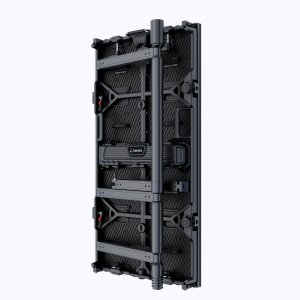
At Coblinks, our MD Series is designed for indoor and outdoor live-event applications, with outdoor pixel pitches of 2.9 mm, 3.91 mm, and 4.81 mm. The outdoor configurations use a magnesium-alloy cabinet, weigh 7 kg for the 500 × 500 mm version and 10.5 kg for the 500 × 1000 mm version, and provide 5,000 cd/m² brightness, a refresh rate of at least 3,840 Hz, and IP65 protection. Front-and-rear maintenance, strong magnetic connections, curved configurations of 0°/±2.5°/±5°, and an optional foldable wind-resistant frame support practical event deployment.
Physical flexibility can matter when an LED screen outdoor deployment needs to appear across different event environments. A modular display allows the overall configuration to adapt to available space, while maintenance access can make servicing less disruptive during a busy schedule. These considerations become more significant when a display is transported and installed repeatedly.
The visual result should always remain connected to the purpose of the installation. A sports venue may prioritize score information and sponsor exposure, whereas a product launch could emphasize cinematic imagery and brand storytelling. An exhibition environment might instead require a combination of product visuals, corporate messaging, and directional information.
Conclusion
Memorable outdoor branding comes from the relationship between technology, placement, content, and audience behavior. A display can attract attention, yet meaningful recognition depends on what viewers see, how quickly they understand it, and whether the surrounding experience reinforces the same identity.
We at Coblinks consider these practical factors when developing LED display solutions, giving brands a foundation for visual communication across events, commercial spaces, and public environments. Used thoughtfully, an outdoor LED screen can become more than a large-format advertising surface—it can form a recognizable part of the physical experience surrounding a brand.