
During a live event or commercial presentation, content may need to change within seconds. Operators may switch between video sources, adjust screen layouts, display live feeds, or update information without interrupting the presentation. An LED panel wall provides the physical display surface, while the control system determines how efficiently that visual information reaches the screen.
At Coblinks, we design and manufacture professional LED display products for demanding applications, including rental and touring markets. Our role is to provide the display hardware and custom solutions that overseas rental companies and professional AV partners can integrate into their own projects. Understanding how an LED panel works with a control system is therefore important when selecting equipment for real time content applications.
How an LED Panel Wall Handles Real Time Content
A large display is normally built from multiple modular cabinets or panels. Content from a video source first enters a controller or video processor, where the signal can be processed and configured for the required display area. The processed data is then transmitted to the LED screen through the appropriate control architecture.
Professional LED control systems can support multiple input sources, screen configurations, and real time adjustments. For example, NovaStar controllers can process video signals and transmit the processed content to LED screens through Ethernet or optical connections. Some systems also support functions such as low latency processing, screen configuration, and multiple controller cascading.
This means an LED panel wall is not simply a collection of illuminated modules. It is part of a complete visual system in which display hardware, receiving cards, controllers, processing equipment, and content sources work together.
Why Refresh Rate Matters for Live Content
For applications involving cameras, live events, or broadcast production, refresh rate is an important consideration. A high refresh rate can help cameras capture LED content more cleanly and reduce visible flicker or scanning artifacts.
Our CL Series is designed with a refresh rate of at least 7,680 Hz across its listed indoor and outdoor models. The indoor CL1.9, CL2.6, and CL3.91 models use a 500 by 1,000 by 45 mm carbon fiber cabinet, weigh 8.5 kg per cabinet, and provide 1,000 cd/m² brightness. The outdoor CL2.9, CL3.91, and CL4.81 models use the same cabinet dimensions and weigh 9 kg per cabinet, while providing 5,000 cd/m² brightness and IP65 protection.
For an LED panel wall used in live production, these characteristics can help create a display platform suitable for demanding visual environments.
Flexible Hardware Supports Fast Deployment
Real time content control is valuable only when the physical display can also be deployed efficiently. This is particularly relevant to the professional rental market, where equipment may be transported, installed, dismantled, and configured repeatedly.
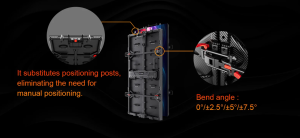
Our CL Series uses a carbon fiber construction with a 45 mm cabinet thickness. Its fast smart lock system allows cabinet connections to be adjusted from -7.5 degrees to +7.5 degrees, while the product page states that the system can reduce assembly time by up to 40 percent compared with regular LED panels with positioning posts. The series also supports front and rear maintenance and optional touring dolly systems.
These features allow rental companies to concentrate on their own content workflow while relying on a display platform designed for rapid physical deployment. As a manufacturer, we provide the hardware rather than rental services, supporting overseas rental companies through product supply and customization.
Building a More Responsive LED Display Workflow
Real time content control can involve more than simply changing videos. Professional video wall management systems can combine IP streams, video captures, local applications, layouts, banners, and other sources. For example, Datapath describes video wall software that allows operators to manage multiple content sources, change layouts, and control walls remotely.
The LED panel itself therefore needs to be considered as one component within the overall signal chain. Selecting the appropriate pixel pitch, cabinet design, brightness, refresh rate, maintenance method, and installation structure can influence how effectively the finished system performs.
For rental and touring applications, our CL Series offers indoor pixel pitches of 1.9 mm, 2.6 mm, and 3.91 mm, while outdoor options include 2.9 mm, 3.91 mm, and 4.81 mm. This range allows customers to select a configuration according to viewing distance and operating environment.
Our Approach to Professional LED Display Solutions
At Coblinks, we develop and manufacture LED display products for rental, touring, commercial, and other professional applications. Our capabilities cover LED display R&D, manufacturing, OEM, and ODM services, allowing customers to adapt display hardware to different control systems and project requirements.
Coblinks supplies LED panel products to customers in Europe, America, Japan, and South Korea, with service networks in Europe, the United States, and Japan. Coblinks offers different options for pixel pitch, cabinet design, installation methods, and maintenance access, allowing rental companies and AV partners to match the display hardware to their specific project needs. Customers can also work with our team on customized configurations when standard products do not fully match their project needs.