
Close-viewing environments expose weaknesses that may remain unnoticed from a distance. Fine text, facial details, charts, and subtle tonal changes can become difficult to interpret if the pixel structure is too visible or the image lacks sufficient density. A small LED screen display can address space limitations while supporting detailed visual presentation, provided its pixel pitch, image processing, and viewing distance are considered together.
At Coblinks, we approach close-viewing applications by examining how the screen will actually be experienced rather than judging performance from physical dimensions alone.
Understanding the Close-Viewing Challenge
People sitting several meters from a large display generally perceive the image differently from viewers positioned directly in front of a compact wall. At short distances, individual pixels can become more noticeable, particularly across uniform backgrounds and fine graphic elements. The visual effect may appear as graininess or reduced smoothness rather than an obvious lack of resolution.
Pixel pitch is central to this relationship. Smaller spacing places more pixels within the same physical area, creating a denser image structure. That density can be especially useful in meeting rooms, studios, and monitoring environments where viewers remain relatively close to the screen for extended periods.
A Micro LED display can provide another approach to dense image reproduction because its extremely small LED structures allow substantial pixel density within a restrained physical footprint. Yet pixel size alone does not determine visual quality. Signal processing, grayscale performance, refresh characteristics, cabinet alignment, and content quality all contribute to what viewers ultimately perceive.
Preserving Fine Detail at Short Distances
Text-heavy content creates a demanding test for any close-range display. Thin strokes and small characters contain fewer visual pixels than large graphics, so minor inconsistencies can become apparent more quickly. A display intended for presentations or operational dashboards needs enough image detail to keep these elements distinct.
Color transitions present a similar challenge. A smooth gradient may reveal uneven tonal steps or visible pixel structure more readily than a bold graphic. High grayscale processing can help reproduce more subtle differences between adjacent tones, which becomes useful when the audience is close enough to inspect the image rather than simply glance at it.
The physical dimensions of the installation should also correspond with the content canvas. A small LED screen display does not necessarily need to reproduce an enormous image area if its purpose is detailed close-range communication. A carefully sized wall can provide enough visual real estate while keeping important information within a comfortable field of view.
Display Construction for Professional Interiors
Close viewing changes the importance of physical construction as well as image specifications. Uneven cabinet alignment, inconsistent module surfaces, or visible transitions can interrupt an otherwise detailed image. Professional installations often require careful mechanical integration because viewers have enough proximity to notice small irregularities.
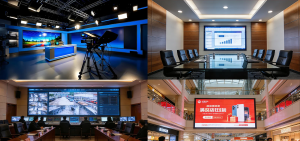
The Coblinks CM-S Series uses 4-in-1 technology designed to produce a smoother image with reduced graininess, with applications including boardrooms, control rooms, and studios where audiences remain nearby. Its construction illustrates how LED packaging can influence the perceived coherence of an image beyond the numerical pixel pitch. A Micro LED display intended for similar environments should be evaluated through both its pixel structure and the conditions under which viewers will inspect it.
Content processing should not be overlooked either. A high-density Micro LED display receiving low-quality source material cannot recreate details that were never present in the original signal. Native-resolution assets, suitable scaling, appropriate sharpness settings, and correctly configured processors all contribute to the final presentation.
Matching Screen Size with Viewing Behavior
A compact display is most effective when its physical scale matches the way people use the room. In a boardroom, participants may look between a presentation surface, other attendees, and documents on the table. A control-room operator may spend much longer examining a fixed section of the wall. Studio environments introduce another consideration because cameras can capture visual characteristics that viewers might not notice directly.
Screen brightness should also be considered according to ambient lighting rather than maximized without context. Excessive brightness in a controlled indoor space can create visual fatigue, while insufficient output may reduce contrast against strong room lighting. The goal is a balanced image that remains comfortable during prolonged viewing.
Viewing angle adds another variable. Not every person sits directly in front of the center of the screen, so image consistency across the audience area matters. A display specification that performs well only from a narrow position may be less suitable for collaborative environments where people observe the same content from different seats.
Conclusion
High-resolution close viewing is not achieved by reducing screen size alone. Pixel pitch, LED packaging, grayscale behavior, processing quality, brightness, viewing angle, and content resolution interact to determine whether detailed imagery remains natural at short distances. A small LED screen display can offer an efficient format for information-rich interiors, while fine-pitch technologies provide greater pixel density where close inspection is expected.
At Coblinks, we evaluate these factors as parts of one visual experience, giving attention to both the technical architecture and the people who will spend time looking at the screen. That approach makes it easier to match display characteristics with the realities of boardrooms, studios, control spaces, and other close-viewing environments.