
The requirements of an outdoor LED display can change significantly from one project to another. A roadside billboard, stadium screen, and commercial facade may face very different conditions in terms of viewing distance, weather exposure, installation, structure, and maintenance.As an LED display manufacturer, we recommend evaluating the complete project before deciding on an outdoor LED screen.
Start With the Project Environment
The first step is to understand where the display will operate. An outdoor advertising installation may remain in one location for years, while an event display may need to be assembled, transported, and installed repeatedly. The surrounding environment also matters. Direct sunlight, rain, wind, temperature changes, and installation height can all influence the appropriate display specification.
For example, a permanent commercial installation should prioritize reliable weather protection and convenient maintenance. A display used for outdoor events may place greater emphasis on lightweight construction, rapid assembly, transportation, and structural stability. By defining these requirements first, buyers can narrow the available outdoor LED screen options more efficiently.
Match Pixel Pitch With Viewing Distance
Pixel pitch is another important consideration. Generally, a smaller pixel pitch provides greater pixel density and is suitable when viewers or cameras are relatively close to the display. Larger pixel pitches can be more practical for large outdoor screens viewed from greater distances.
Our MD Series provides outdoor pixel pitch options of 2.9 mm, 3.91 mm, and 4.81 mm. This range allows customers to select a configuration according to project size and expected viewing distance. The outdoor models use SMD1415 for MD2.9 and SMD1921 for MD3.91 and MD4.81. All three outdoor configurations provide a brightness of 5000 cd/m² and a refresh rate of at least 3840 Hz.
For an LED screen for advertising outdoor, these specifications can help maintain clear and vivid content in bright outdoor environments. However, pixel pitch should always be considered together with screen size and audience distance rather than treated as an isolated specification.
Consider Weather and Structural Requirements
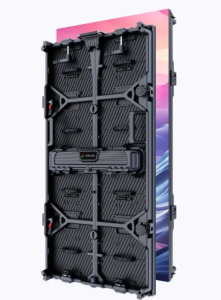
Outdoor displays must be designed for demanding conditions. The MD Series outdoor models have an IP65 rating and an operating temperature range of -20°C to +50°C according to our product specifications. They also use magnesium alloy cabinets and support front and rear maintenance.
Structural design is equally important, especially for suspended or temporary installations. Our MD Series incorporates a foldable wind-resistant frame, while its curved locking system supports 0°, ±2.5°, and ±5° configurations. The panels can also be assembled into irregular shapes, providing greater flexibility for creative outdoor projects.
These characteristics make the MD Series suitable for projects where both visual performance and installation flexibility are important. Buyers should nevertheless evaluate local structural, electrical, and installation requirements with qualified professionals for each project.
Choose Installation and Maintenance Features Carefully
Installation efficiency can have a direct effect on project costs and deployment schedules. Heavy cabinets may require more labor and equipment, while modular lightweight designs can simplify handling. The MD Series uses an aerospace-grade magnesium alloy frame, with the 500 × 500 mm cabinet weighing 7 kg and the 500 × 1000 mm cabinet weighing 10.5 kg for the outdoor versions.
Maintenance should also be considered before purchasing an outdoor LED screen. Front and rear maintenance gives technicians more flexibility when accessing modules and components. The MD Series also uses a magnetic design to support faster panel positioning and assembly.
For outdoor touring and event applications, transportation is another consideration. Our MD Series can be paired with a touring dolly system designed to simplify transportation and setup.
Select a Solution That Fits the Business Model
Different buyers may require different levels of customization. A permanent advertising project may need a specific cabinet configuration and installation structure, while an overseas rental company may prioritize lightweight panels, fast setup, transportation efficiency, and repeated deployment.
At Coblinks, we focus on LED display manufacturing, R&D, and customized solutions. We provide professional LED display products for international customers and have experience supporting ODM projects in Europe, America, Japan, and Korea. Our company also maintains an ISO 9001 quality management system and has been recognized as a National High-Tech Enterprise and a Specialized, Refined, Unique, and Innovative SME.
When customers are sourcing an LED screen for advertising outdoor, we can work with them to determine the appropriate configuration according to the application, environment, installation method, and project requirements. Our cooperation process includes project consultation, customized solution design, production, and quality control.
Make the Selection Based on the Complete Project
An outdoor LED display should be selected according to how and where it will be used, rather than by comparing specifications alone. Viewing distance, installation conditions, weather exposure, maintenance access, and transportation all need to be considered together before the final configuration is determined.
For projects that require a balance between outdoor visibility, structural flexibility, and installation efficiency, the MD Series offers multiple pixel pitch options and a lightweight cabinet design for different applications. The configuration can also be adjusted to suit specific site conditions and operating requirements.
Project consultation, solution design, production, and quality control form the basis of Coblinks’ support for international LED display projects. This project-oriented approach helps buyers select practical specifications for their intended application while avoiding unnecessary configurations and reducing potential issues during installation and long-term operation.